
A Metrolink Sunday from Downtown Riverside to Union Station
Exploring downtown LA via Metrolink from Moreno Valley.
Some Sundays call for a slow cup of coffee. This one called for a train ticket.
My wife and I have talked for years about doing Los Angeles "on foot and by rail" — no freeway, no parking meters, just the Metrolink and our own two feet. So on a recent Sunday, we drove the short distance from Moreno Valley to the Riverside-Downtown Metrolink Station, boarded the 91/Perris Valley Line, and let the train do the driving all the way into Union Station. By the time we boarded the train home that evening, our step counter read just under nine miles. Here's everywhere it took us.
Olvera Street and El Pueblo: Where Los Angeles Begins
Union Station drops you within a five-minute walk of the oldest part of the city, so that's where we started. Olvera Street is a narrow, colorful marketplace lined with vendors selling leather goods, candles, and enough churros to fuel the whole day ahead. But the real draw for history lovers is what surrounds it: El Pueblo de Los Angeles Historical Monument, a 44-acre district holding 27 historic structures.
We ducked into the Avila Adobe first — built around 1818, it's the oldest standing house in Los Angeles and once served as a headquarters for U.S. naval forces during the Mexican-American War. Just steps away sits the Pico House, an ornate 1870 hotel built by Pío Pico, the last Mexican governor of Alta California, and across the plaza, the tiny Masonic Hall, considered the oldest building in the city. We also passed La Placita Church (Our Lady Queen of the Angels), the city's original parish church, still holding Mass on the plaza where Los Angeles itself was founded in 1781. Above the street itself, tucked into a viewing platform, sits the América Tropical Interpretive Center, home to the restored 1932 David Alfaro Siqueiros mural — its stark political imagery got the whole thing whitewashed within a year of painting, and it stayed hidden for decades before a careful Getty Conservation Institute restoration brought it back.
The Firehouse, Chinese American, and Italian American Museums
From the plaza we hit three small museums in quick succession, each tucked into a historic building rather than a purpose-built one — part of what makes El Pueblo feel less like a tourist attraction and more like a preserved neighborhood.
The Old Plaza Firehouse Museum occupies L.A.'s first official fire station, built in 1884, complete with a horse-drawn steam engine and 19th-century firefighting gear. A block over, the Chinese American Museum sits inside the Garnier Building, one of the last remaining structures from L.A.'s original Chinatown, and traces the Chinese American experience in Southern California from the Gold Rush era forward. The Italian American Museum of Los Angeles, housed in the historic Italian Hall, rounds out the trio — a reminder that L.A.'s "melting pot" reputation isn't a modern marketing line, it's baked into these three blocks.
Up Through Chinatown
We continued north into L.A.'s modern Chinatown, established in the 1930s after the original settlement near the plaza was cleared to make way for Union Station itself. Central Plaza's pagoda-topped gateways and neon signage make for a completely different visual register than El Pueblo — worth the extra ten minutes of walking even if you're not stopping to eat.
Grand Park to the Music Center
Heading back south and west, we passed through the newer Los Angeles State Historic Park area before making our way toward the Music Center complex — the cultural anchor of Bunker Hill. Walt Disney Concert Hall, Frank Gehry's stainless-steel sail of a building, is worth circling completely; the curves read differently from every angle, and the public gardens tucked behind it are an easy, free place to catch your breath. Next door, The Broad houses one of the country's most talked-about contemporary art collections behind its honeycomb-latticed exterior — we didn't have a same-day reservation, but even the building itself is a destination. We walked past the Dorothy Chandler Pavilion, home of LA Opera, without going inside — it's worth a return trip on its own for a performance. From there, Grand Park stretches out toward Los Angeles City Hall, whose 27th-floor observation deck offers a free panoramic view of most of the route we'd already covered on foot.
Fort Moore and the Mormon Battalion
On the walk up Hill Street toward the Cathedral, we passed the Fort Moore Pioneer Memorial — an enormous bas-relief monument, the largest of its kind in the country, marking the site of the first American fort in Los Angeles. It was built in 1847 by the Mormon Battalion, a volunteer unit of Latter-day Saint pioneers who served during the Mexican-American War, alongside U.S. 1st Dragoons. The memorial's terra cotta panel depicts the raising of the American flag over the fort on July 4, 1847 — the city's first Independence Day under U.S. rule. We didn't stop long, but it's easy to see why locals call it the most important monument nobody's ever heard of.
The Cathedral of Our Lady of the Angels
Before heading down toward Little Tokyo, we made one more stop on Temple Street: the Cathedral of Our Lady of the Angels. From a distance its stark, angular concrete facade and near-total absence of right angles reads almost secular — more than one visitor has assumed it's something other than what it is. It's actually the seat of the Roman Catholic Archdiocese of Los Angeles, designed by Pritzker Prize-winning Spanish architect Rafael Moneo and dedicated in 2002 to replace the earthquake-damaged Cathedral of St. Vibiana. Inside, the building is genuinely striking — 27,000 square feet of Spanish alabaster panels let in soft, amber-toned light instead of stained glass, and the main doors were cast by sculptor Robert Graham. At 333 feet long, it's just a foot longer than St. Patrick's Cathedral in New York, reportedly by design.
Little Tokyo and the Go For Broke Monument
From Bunker Hill we dropped back down toward Little Tokyo, walking through the Japanese Village Plaza with its pagoda-style koban and mix of shops and restaurants. Given my own background as a veteran, one stop here mattered more to me than I expected: the Go For Broke Monument, a black granite memorial engraved with the names of more than 16,000 Japanese American soldiers who served in segregated Army units during World War II — including the 100th Infantry Battalion and the 442nd Regimental Combat Team, one of the most decorated units in U.S. military history. It sits quietly at the north end of Central Avenue, easy to miss if you're not looking for it, and worth every minute if you are. We walked by the Japanese American National Museum just across the plaza, but it's currently closed for renovation and set to reopen in late 2026 — one for the return trip. But we did get to visit a much smaller version of the Museum right next door. We passed the Geffen Contemporary at MOCA, tucked into a converted warehouse at the far end of the same district, but it is also temporarily closed.
Lunch at Grand Central Market
By early afternoon we'd earned lunch, and Grand Central Market on Broadway delivered — a sprawling, century-old food hall with everything from tacos to ramen to fresh-pressed juice under one roof. It's one of the few places downtown where the crowd feels genuinely mixed: office workers, tourists, and longtime Angelenos all elbow-to-elbow at the counters.
The Bradbury Building
No downtown walking tour is complete without the Bradbury Building, just across the street from Grand Central Market. From the outside it's an unremarkable 1893 brick office building. Inside, it's one of the most photographed interiors in Los Angeles — a five-story atrium of wrought iron, open cage elevators, and warm skylight pouring down over Victorian tile floors. Film buffs will recognize it instantly from Blade Runner and dozens of other productions; architecture buffs will recognize it as one of the best-preserved examples of Victorian commercial design left in the country. A block away, Angels Flight, the world's shortest funicular railway, still shuttles riders up and down Bunker Hill for a couple of dollars, and nearby Biddy Mason Memorial Park on Spring Street honors the formerly enslaved woman who became one of Los Angeles's first Black landowners and philanthropists. We walked right past The Last Bookstore, a cavernous used-and-new bookshop a block off Spring Street known for its book-tunnel art installation, but didn't go in this time — next visit, for sure.
Back to Union Station
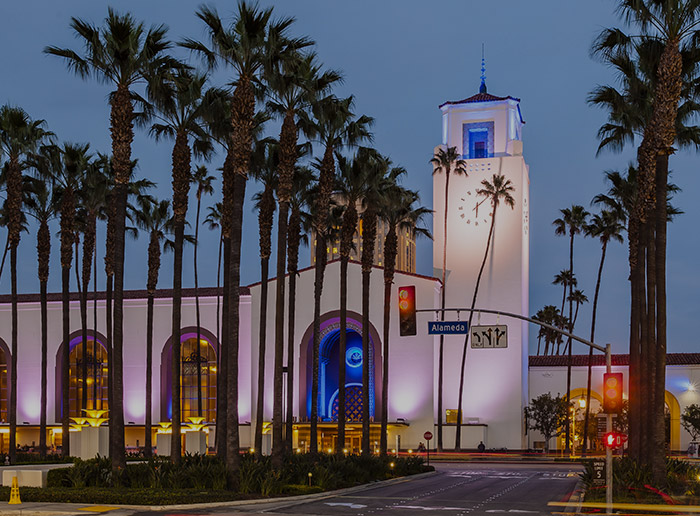
From the Bradbury Building it was a straight shot back to Union Station itself, which is worth treating as a destination rather than just a transit hub. Opened in 1939, it's often called the last of America's great rail stations — a striking blend of Mission Revival, Streamline Moderne, and Spanish Colonial styles, with a cavernous main hall of leather chairs, tiled floors, and towering windows that hasn't changed much in the better part of a century.
Still on the List
A few more spots within easy reach of this route, for anyone plotting a second pass: the Triforium, a quirky 1975 sculpture of colored glass prisms near City Hall; and the interior of the Dorothy Chandler Pavilion or LA Opera, if you can time it to a performance.
The Verdict
Nine miles, six museums, two concert halls, one cathedral, and one very good market lunch — all without a single freeway on-ramp. If you're anywhere in the Inland Empire, the Metrolink 91/Perris Valley Line puts this entire day within reach for the cost of a round-trip ticket. Pack good shoes, get an early start, and let the train do the work of getting you there.