
Sometimes a Thrift Store Is More Than a Thrift Store
Last week I emceed the ribbon cutting of Shop 4 A Cause, the new thrift store operated by the Building Up Lives Foundation on Perris Boulevard. What I saw there wasn't just the opening of another storefront — it was proof that Moreno Valley is a community, not just a city.
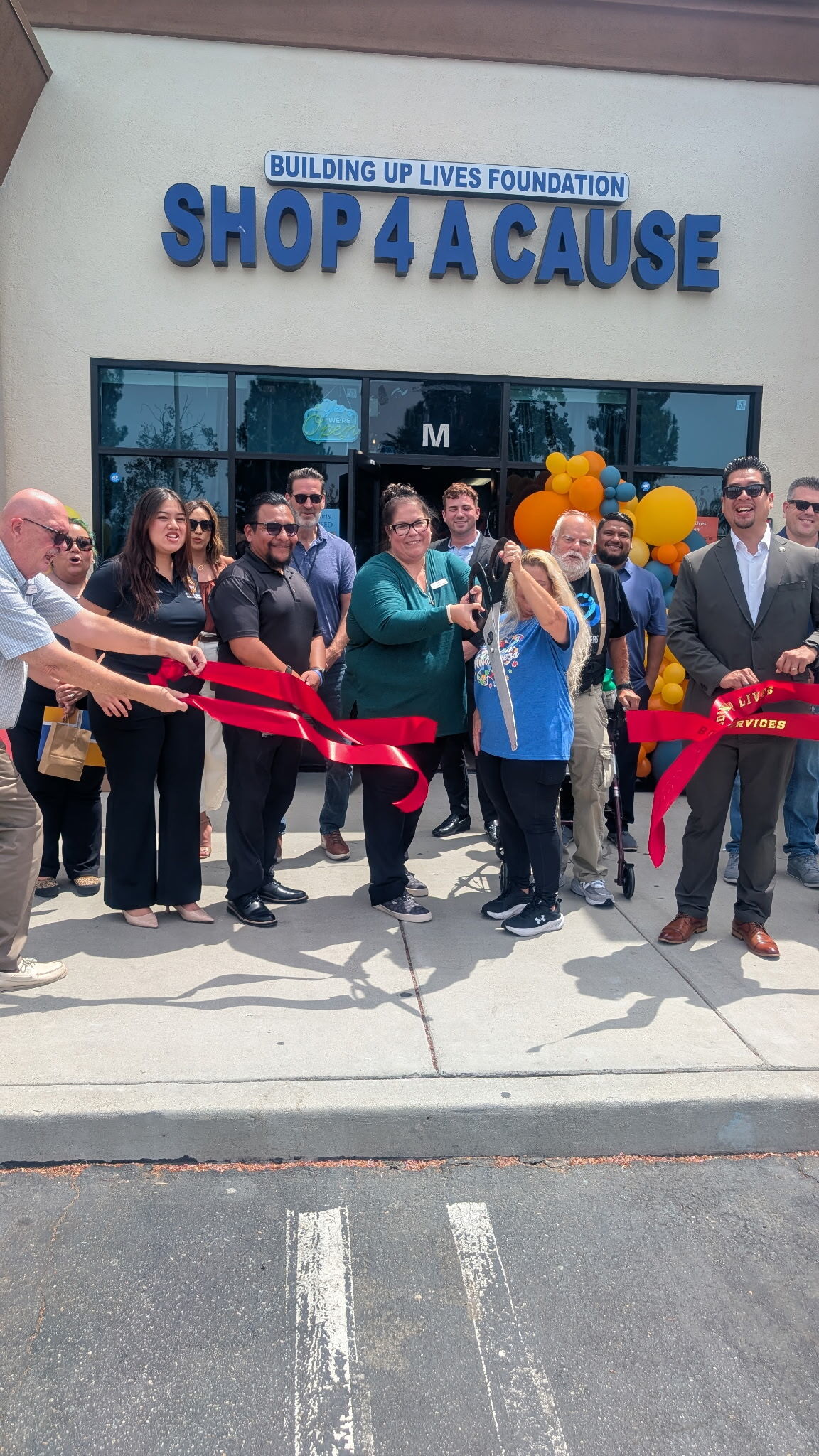
There are certain moments in community life that seem ordinary on the surface but, if you stop and think about them, represent something much bigger.
Last week, I had the privilege of serving as the emcee for the ribbon cutting of Shop 4 A Cause, the new thrift store operated by the Building Up Lives Foundation on Perris Boulevard in Moreno Valley.
Ribbon cuttings are usually celebrations of something new: a new business, a new investment, a new opportunity. We gather, say a few words, take some pictures, applaud, and then go back to our busy lives.
But standing there with JulieAnn and Armando Pedroza, the founders and driving force behind Building Up Lives Foundation, I found myself thinking that this particular ribbon cutting represented something more important than the opening of another store.
It represented what it means for a community to care.
What Does a Community Owe Its Neighbors?
We often talk about community in terms of geography.
We live in Moreno Valley. We work here. Our children go to school here. We shop at the same stores, drive the same streets and complain about the same traffic.
But geography alone doesn't make a community.
A community is created when the lives of individual people become connected by something deeper than simply sharing a ZIP code.
It happens when we recognize that the person struggling to pay the rent is not somebody else's problem.
The family experiencing homelessness is not an abstraction.
The woman trying to escape an abusive situation is not just a statistic.
The person who has lost a job and doesn't have enough money for groceries is still our neighbor.
And sometimes, the most meaningful measure of a community is not how successful its most fortunate residents are, but what happens to the people who are having the hardest time.
That is where organizations like Building Up Lives Foundation become so important.
The foundation describes its mission in remarkably simple terms: to heal and rebuild lives. It is an all-volunteer nonprofit that provides food, clothing, hygiene supplies, emergency assistance and other forms of support to people experiencing hardship. Its work also includes homelessness assistance, domestic-violence support and other community resources.
Those words—heal and rebuild—are worth considering.
Because rebuilding a life rarely happens through one grand gesture.
More often, it happens through a series of small acts.
A meal.
A clean shirt.
A pair of shoes.
A blanket.
Someone who listens.
Someone who knows where to find help.
Someone willing to stand beside you when life has become overwhelming.
And sometimes, it happens because somebody creates a place where all of those things can come together.
The Beautiful Economics of a Good Cause
That is what makes Shop 4 A Cause particularly interesting to me.
A thrift store might appear to be about buying and selling used merchandise.
But when the store is connected to a nonprofit, something interesting happens.
An item that somebody no longer needs can become a resource for somebody else.
A donation becomes inventory.
Inventory becomes a purchase.
A purchase becomes funding.
And funding becomes assistance for someone who needs it.
In other words, something that might otherwise have been discarded can continue its journey through the community and ultimately help rebuild someone's life.
There is something almost poetic about that.
We live in a culture that is often focused on the new—the newest phone, newest car, newest house, newest everything.
But thrift stores remind us that value and newness are not the same thing.
An old table can still serve a family.
A jacket that no longer fits one person can keep another person warm.
A household item sitting unused in someone's garage can become useful again.
And when those transactions support people in need, the value of the object becomes greater than its price tag.
It becomes part of a cycle of generosity.
The People Behind the Mission
But organizations don't change communities by themselves.
People do.
And one of the things that struck me about the Building Up Lives Foundation is how personal its work is.
JulieAnn and Armando Pedroza aren't simply names on an organizational chart. They are deeply involved in the work of the foundation.
The organization's own story describes JulieAnn as its founder and executive director and Armando as a longtime volunteer and leader. Public records identify the foundation as a Moreno Valley nonprofit established in 2018 and recognized as a 501(c)(3) charitable organization.
That kind of commitment matters.
Because there is a difference between believing that people need help and actually being willing to get your hands dirty helping them.
Community service is rarely glamorous.
There are no guarantees.
There are difficult stories, difficult circumstances and difficult days.
Yet people like JulieAnn and Armando keep showing up.
And perhaps that is one of the greatest gifts a community can receive: people who are willing to show up consistently.
We All Have Something to Give
One of my favorite things about community organizations is that they give ordinary people a way to participate.
You don't have to be wealthy to make a difference.
You don't have to start a nonprofit.
You don't have to write a giant check.
Sometimes you simply clean out your closet and donate what you no longer need.
Sometimes you stop by a thrift store and purchase something you were going to buy somewhere else anyway.
Sometimes you volunteer a few hours.
Sometimes you tell a person who is struggling, "I know somebody who can help."
Sometimes you simply pay attention.
That last one may be more important than we realize.
We tend to think of helping others as something extraordinary.
But strong communities are built through ordinary people doing ordinary things with extraordinary consistency.
The City of Moreno Valley's current community-development plans even recognize the role Building Up Lives Foundation plays locally, including funding for its clothing and emergency-supply program.
That tells us something.
Government has an important role in addressing community needs. Businesses have an important role. Nonprofits have an important role.
But none of them can do it alone.
A community works best when all of those pieces fit together.
What Kind of Moreno Valley Do We Want?
This is the question I keep coming back to.
Every city has challenges.
Moreno Valley is no different.
We have people experiencing homelessness. We have families struggling with rising costs. We have people dealing with domestic violence, hunger, unemployment and circumstances that can turn a stable life upside down surprisingly quickly.
We can respond to those realities by pretending they don't exist.
Or we can decide that they are our problems, too.
I don't believe a great community is one where nobody ever falls.
People fall.
Businesses struggle.
Families encounter crises.
Lives sometimes take unexpected turns.
A great community is one where, when somebody falls, there are people willing to reach down and help them back up.
That is what I see in organizations like Building Up Lives Foundation.
And that is why I think a place like Shop 4 A Cause matters.
It isn't just another storefront on Perris Boulevard.
It is another connection point in the web of people and organizations that make Moreno Valley a community rather than simply a city.
You can shop there.
You can donate there.
You can volunteer.
You can support the organization financially.
But perhaps most importantly, you can become part of the idea behind the organization: that lives can be rebuilt, circumstances can change, and people should not have to face their hardest moments completely alone.
The Real Meaning of a Ribbon Cutting
At the end of a ribbon cutting, the ribbon gets cut.
The cameras come out.
People applaud.
Then everyone goes home.
But the real celebration isn't the ribbon.
It is what happens afterward.
It is the person who walks through the doors looking for something they can afford.
It is the donation that someone drops off because they have more than they need.
It is the volunteer who gives up an afternoon.
It is the family that gets a little help at precisely the moment they need it.
It is the person who was struggling yesterday who eventually finds their footing again.
That is the real measure of whether a place like Shop 4 A Cause succeeds.
Not how many things it sells.
Not how busy the parking lot becomes.
But how many lives are touched because people in Moreno Valley decided that helping one another is worth the effort.
I was honored to be there to help celebrate the opening.
But more than anything, the ribbon cutting reminded me of something I think is easy to forget:
A community is not something we simply live in. It is something we create.
Every time we support a local business, volunteer for an organization, donate something we no longer need, or take the time to help someone who is struggling, we are making a decision about what kind of community we want Moreno Valley to be.
Shop 4 A Cause is one small place where those decisions can come together.
And perhaps that is why this particular ribbon cutting felt different.
We weren't just celebrating the opening of a thrift store.
We were celebrating an idea.
That people matter.
That second chances matter.
That generosity matters.
And that when we invest in one another, we are investing in the place we all call home.
That's what community looks like.
And that's something worth celebrating.